Soldier. Farmer. Father. He carried gallantry medals and a scar on his forehead from the Indo-Pakistan wars. In Gingee everyone called him Raj. He could stop a street fight just by walking past.
Their life, as remembered
13 memories
His last letter
He gave away what he had
The army pay was not much. Supporting a family of eight on it was hard. I know this from his last letter. He wrote about giving money to the church, to the priest, to his godfather. In the entire letter, he found one small corner for himself. He was OK. She should not worry. His health was fine.
He taught me Hindi
He taught me three things I still carry. Hindi (the language of command, of the north, of the institution he had given his adult life to). He wanted me to join the army as an officer, and he prepared me for it. To be brave. And always look after each other. He meant my siblings. He said it more than once.
What I wanted was to be an Air Force fighter pilot. I never got to tell him that properly, as one adult to another. He died before that conversation could happen.
My mother
The medals
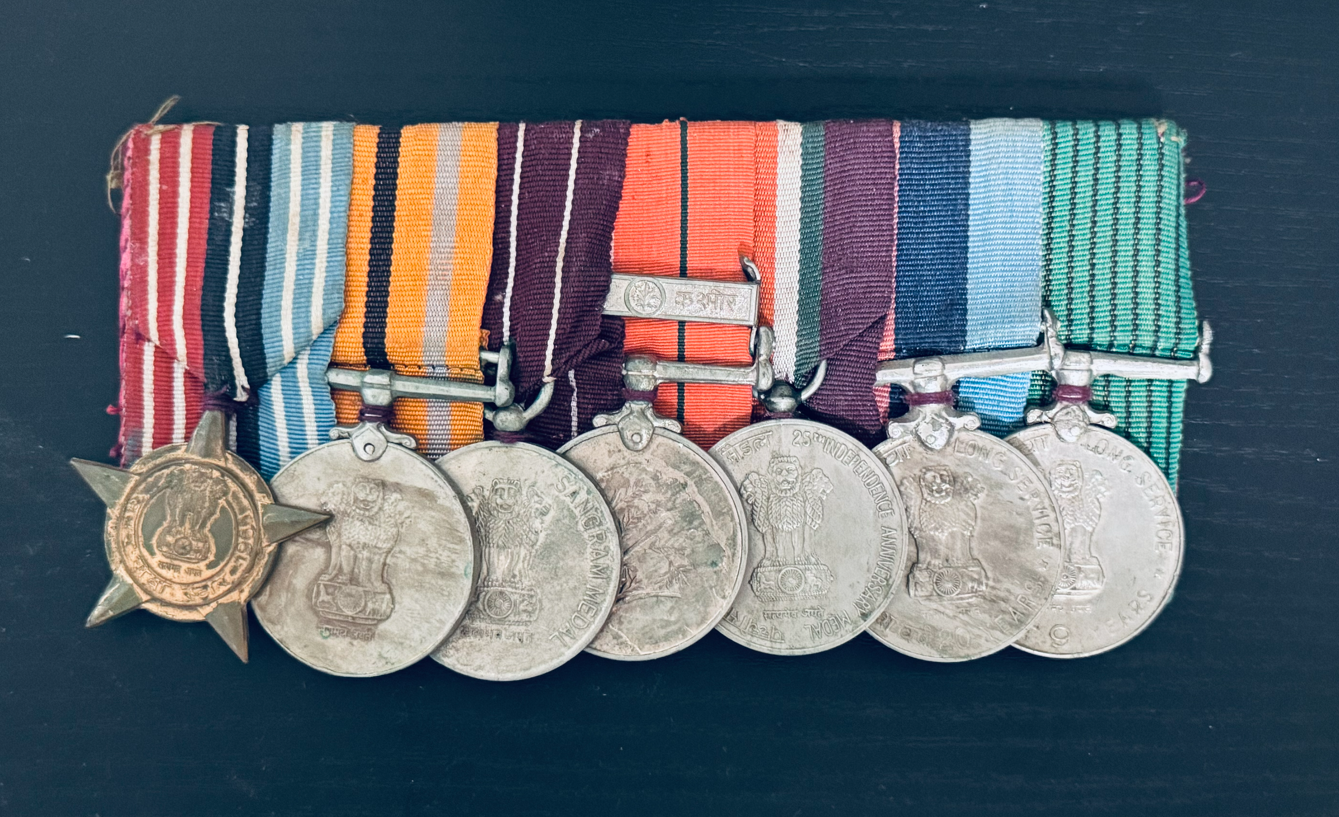
I found them in a drawer. I asked my mother about them and she was fine with me keeping them. When I asked about each one, she named two: the Samar Seva Star and the Sangram Medal. The first for the 1965 war, the second for 1971. The others she could not name. The army does not give those medals lightly.
His military gallantry medals. Earned through the Indo-Pakistan wars and peacekeeping service.
My mother
Peacekeeping service
My mother told me this. Beyond the wars, he served in peacekeeping operations. A soldier who had seen combat, sent to hold the line between others. He carried himself quietly into whatever was asked of him.
He came home once or twice a year
That was the rhythm of our family. The army kept him posted away. He would come home on leave once, sometimes twice a year. When he arrived, the house changed. He would go to the farm (we had land in Gingee) and take care of what needed doing. I would go with him sometimes. He was teaching me things, the way fathers do, in the small moments between the work.
I lived in Jammu and Kashmir for a few months
I was five or six. My family went to where he was posted (the army cantonment in Jammu and Kashmir). Too cold. A different world from Tamil Nadu. I remember the landscape, the stillness, the particular quality of the cold. I had a conversation with a neighbour there that I still remember, though I could not tell you now what was said. He was there. We were together. It is one of the few windows I have into his ordinary daily life.
My grandmother and neighbours in Gingee
The man who could stop a street fight
My grandmother told me this. Neighbours in Gingee still do. If there was a fight (neighbours, strangers, anyone) and Raj happened to be walking past, people would stop. They would just leave. Not because he said anything or intervened. Because he had arrived, and nobody wanted to be the person fighting in front of him. He had that kind of presence. I have spent a long time wondering what it feels like to carry that naturally.
1930s
1937
Savarimuthu Antony (Raj)
His full name was Savarimuthu Antony. Savari. Muthu. Muthu means pearl in Tamil, a word that carries honour. In Gingee, Tamil Nadu, where he was born in April 1937, everyone called him Raj. Tall, composed. He was one of those people a town remembers.
1960s
1965
The 1965 Indo-Pakistan War
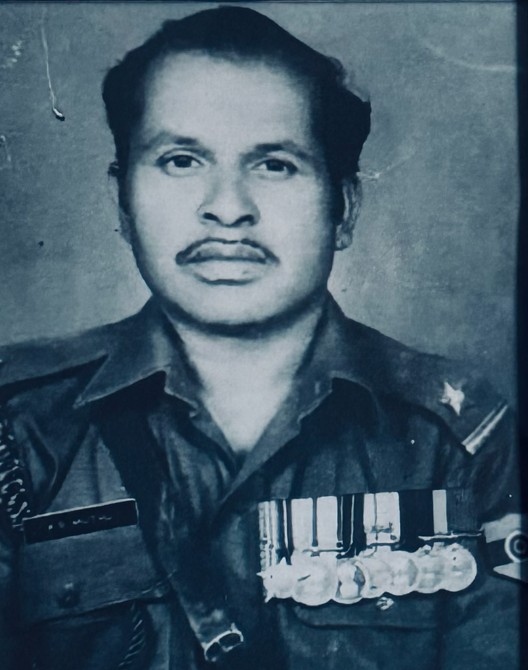
He served in the 1965 Indo-Pakistan War, one of seventeen days of full-scale combat across the Punjab and Kashmir. He was in combat and he was wounded. A shell fragment caught him near the left side of his forehead, and he carried that mark for the rest of his life. For his service in that war he was awarded the Samar Seva Star. He did not talk about what he had seen.
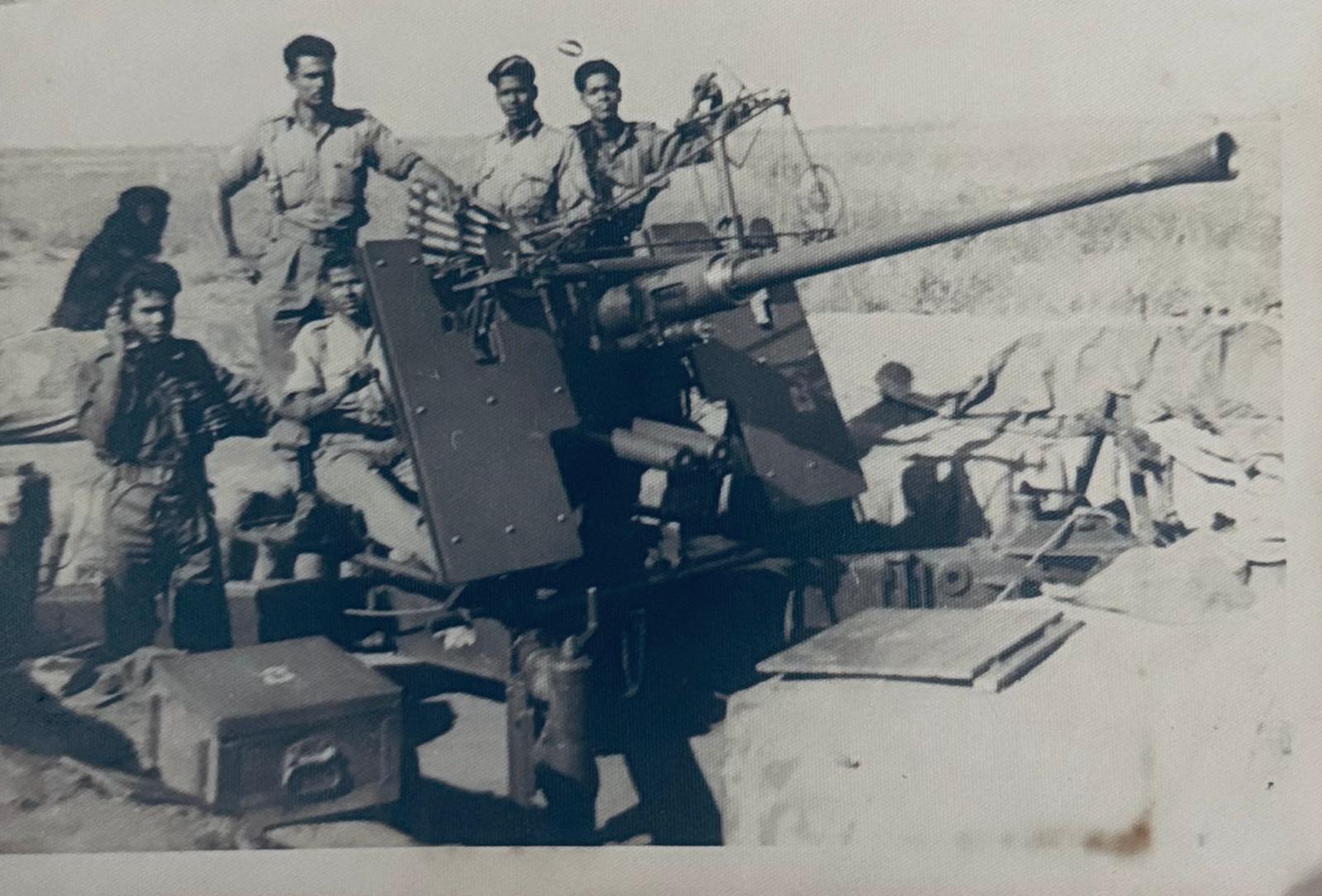
Savarimuthu Antony in uniform. He served in the Indian Army Artillery through the 1965 and 1971 Indo-Pakistan wars.
1967
He married Elizabeth Rani
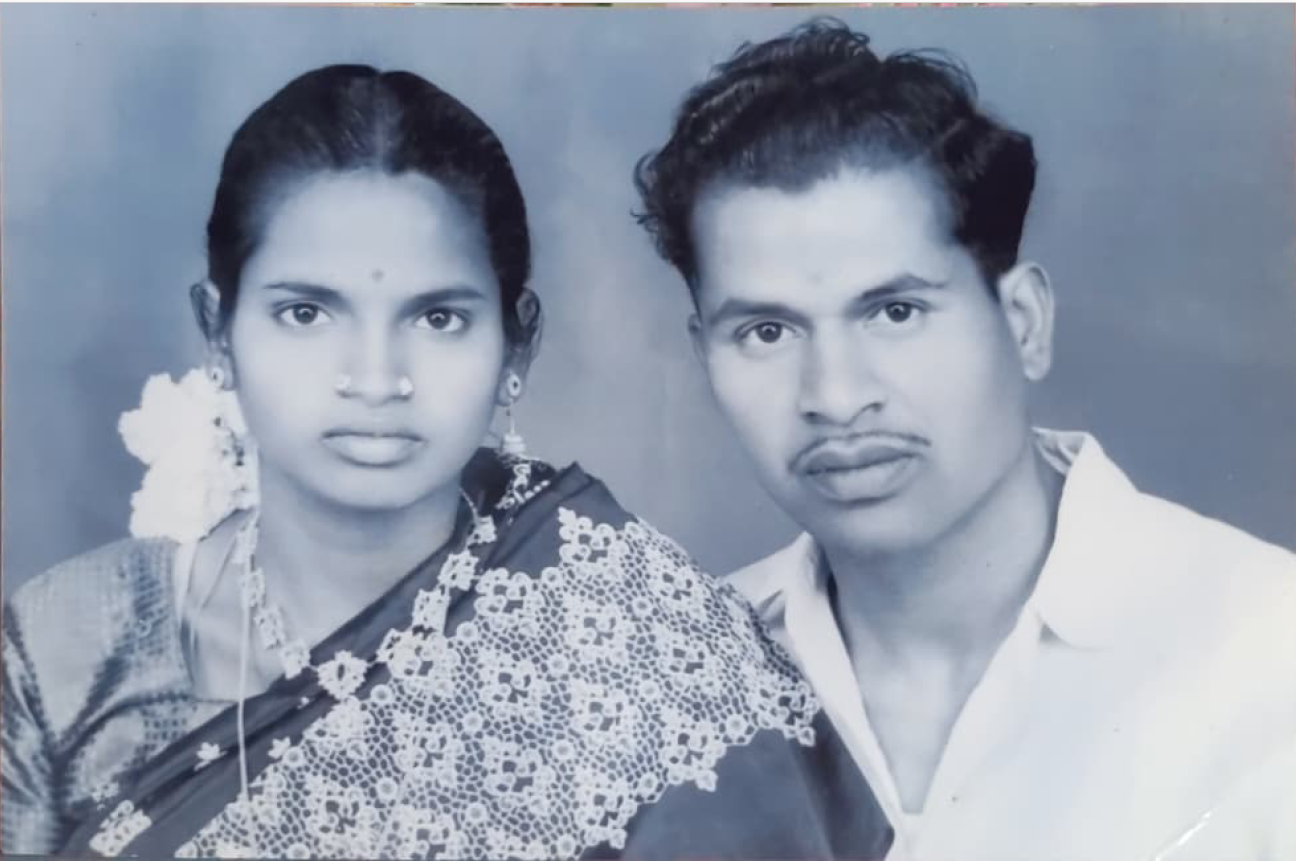
He married Elizabeth Rani and they built a family together. There is an early wedding photograph: the two of them, young, before six children and decades of a life mostly lived apart while he served. My mother still has it. It is one of the few images I have of him at all.
An early photograph of Raj and Elizabeth together, young, before six children and decades of a life mostly lived apart.
1970s
1971
The 1971 Indo-Pakistan War
Six years later he served again, in the 1971 Indo-Pakistan War that ended with the creation of Bangladesh. For his service in that war he was awarded the Sangram Medal, established by the President of India to recognise those who fought in 1971. He came home with both medals and did not speak of either.
1980s
1983
The Republic Day parade
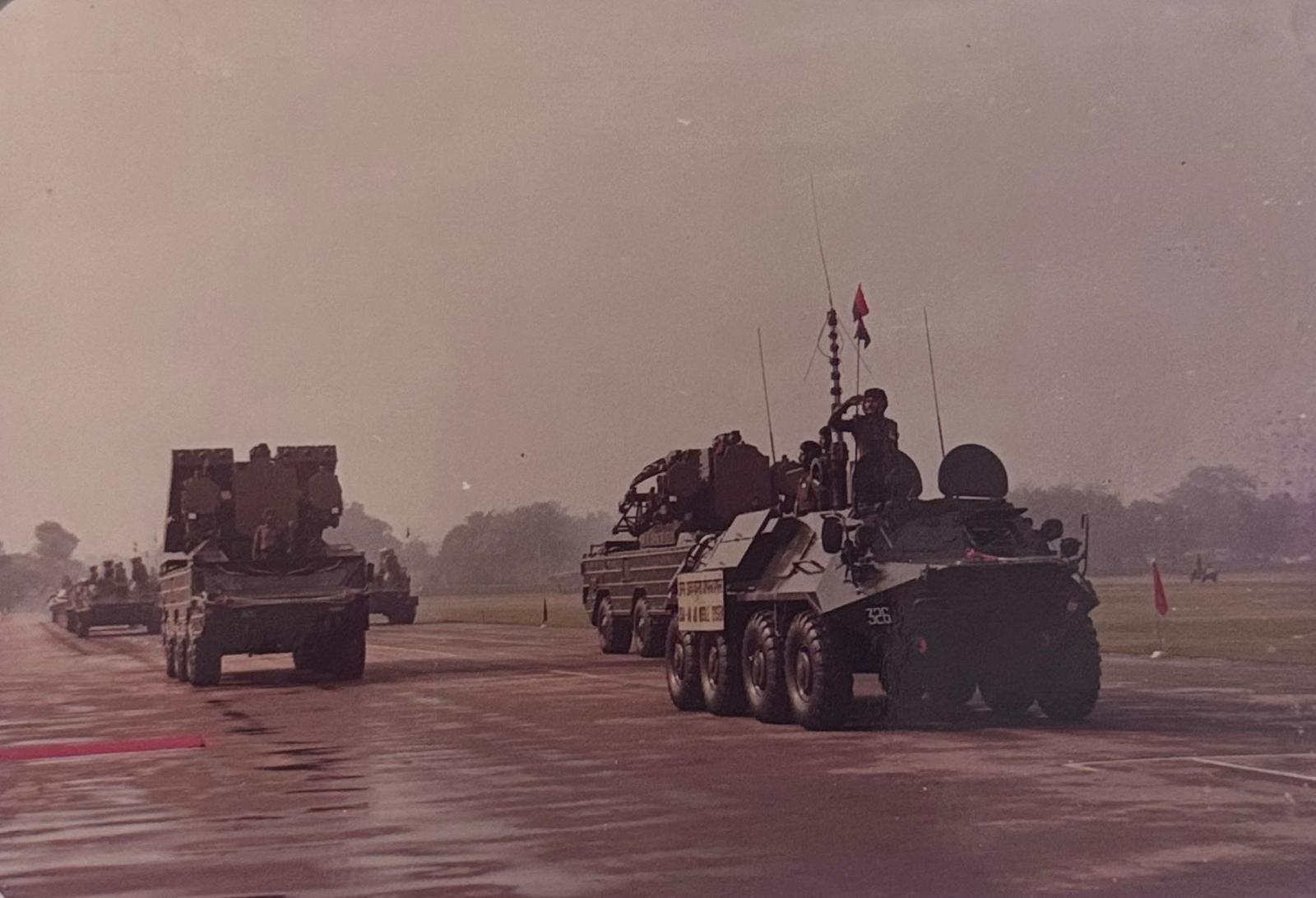
From Jammu and Kashmir, we moved to Delhi. My father was a Subedar in the Artillery, and one January, he took my sister and me to India's Republic Day parade.
We saw Indira Gandhi from a distance, surrounded by a huge convoy. Then came the tanks. My father knew every one of them. He pointed them out to us and explained what each one was.
At one point, my sister and I climbed up and sat on one of the tanks. It was freezing, and both of us were crying from the cold.
My mother had brought coffee in a flask. I remember climbing the steps with it in my hands. Somehow, I dropped it.
The flask broke.
After all these years, the parade, Indira Gandhi, the tanks, my father explaining them one by one, that is the memory I still carry.
India's Republic Day parade, January 26. Raj, a Subedar in the Artillery, brought his children to Delhi to watch — the tanks, the convoy, Indira Gandhi at a distance.
1988
He died on active duty. I was eleven.
He was fifty-one years old, still serving, when he died on active duty. He did not come home for the last time. He was posted away, as he always was, and then he was gone. I was eleven. I had a few moments, a few impressions, the outline of a man I never got to know as an adult. Everything else I have learned secondhand. From my mother Elizabeth. From my brother and sister. From the people of Gingee who still remember him. A teacher. Neighbours. Someone from his church. That is how I know my father. Piece by piece, from people who loved him. This is my attempt to keep those pieces in one place.
Ways to honour Savarimuthu
We are building a network of trusted services to help families honour their loved ones, from grief support to memorial photography and ceremony planning.
Partner services will appear here when available in your area.