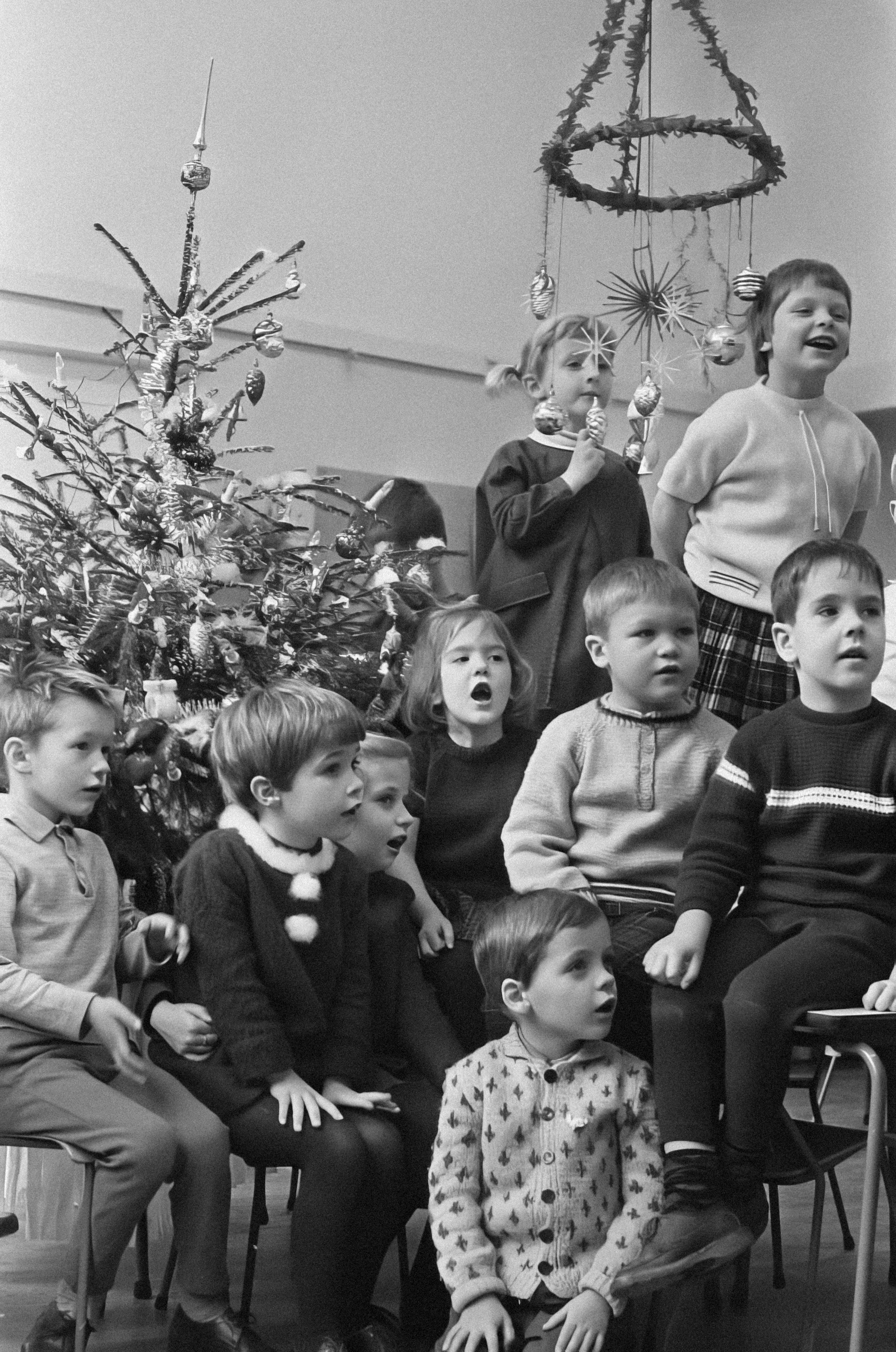
Every Sunday evening after dinner, Eleanor would sit in the green chair by the window and read aloud, sometimes from a book, sometimes stories she invented on the spot.
—
Eleanor's voice, Sunday evening, 1972
Hearing someone's voice across time is something no photograph can do.
My mother always said I came into the world arguing. It was February 14th, which she claimed was a sign I'd always be loved (and perhaps a warning that I'd always expect too much from Valentine's Day). We lived above Mr. Kowalski's tailor shop on Elm Street. I can still smell the wool and steam from the press if I close my eyes. We had very little, but the building was warm and Mr. Kowalski's wife brought soup on Sundays, which mother said was the only proof she needed that there was a God.
Shared by family & friends
“Mum always said Eleanor cried for six hours straight when she was born. Then, apparently, she never cried again. Not at her First Communion, not at my wedding, not even when Dad died. She just set her jaw.”
Margaret Whitfield· Younger sister
1930s
1934
Learning to read with Papa
Papa worked nights at the mill and slept until noon, but every Saturday morning without fail he sat with me at the kitchen table with the newspaper. He never bought books (we couldn't afford them), but he said the newspaper had everything: science, politics, tragedy, comedy. He was right. I have read one every day since I was six years old. After he died in 1958 I kept every Saturday edition for three months before I finally let myself throw them away.
1940s
1941
The day the radio changed everything
I was thirteen. Mother called us in from the yard and turned the radio up. We sat around it like it was a fire, the way families did then. Papa didn't speak for the rest of the day. My brother Tommy was fifteen and immediately announced he would enlist. Mother told him to go wash his hands for supper. That was how she handled things she could not bear. She made something small happen so the large thing had nowhere to land. I have done the same thing my whole life. It does not always work, but it does give your hands something to do.
1947·Columbus, Ohio
The only woman in the room
Professor Aldrich called me "Miss Whitfield" with a particular emphasis that managed to convey both respect and irritation simultaneously. I was the only woman in my pharmacy class. The other students were mostly veterans, older than me, tired, and either suspicious or genuinely kind. There was rarely anything in between. I graduated second in my class. The man who graduated first told me I had done "remarkably well, considering." I have thought about that sentence many times in the seventy years since. I decided on the drive home that it was the greatest compliment I had ever received, and I have treated it as such ever since.
1947·Springfield, Ohio
First day at Elm Street Pharmacy
Mr. Hayward hired me the same afternoon I walked in. He said later he decided in the first thirty seconds, not because I was qualified (which I was), but because I looked at the shelves first and the cash register second. He said that told him everything he needed to know about what I thought the job was for. I worked at that counter for four years. I knew every regular customer's prescriptions, their children's names, and which ones were afraid of needles. I liked knowing. I still do.
Elm Street Pharmacy, Springfield
1950s
1952·Springfield, Ohio
Harold walks in asking for aspirin
He asked for aspirin. We sold aspirin at every counter in the city. He came back the following Saturday for calamine lotion — it was October, there was no poison ivy. The Saturday after that it was something for a cough that sounded entirely invented. By the fourth Saturday I had decided either to marry him or to recommend a doctor. He asked me to dinner before I could choose. He told me years later that he had rehearsed every possible version of the question since the second visit. He settled on "I wonder if you'd allow me to take you to dinner" because it gave me a way to say no gracefully. I did not say no. We were married eleven months later. He was the least graceful person I ever met and the most careful.
1953·Springfield, Ohio
14 Birchwood Lane
We had almost no furniture. Harold had built a kitchen table himself (slightly uneven, it wobbled when you cut anything harder than bread), and we had two chairs, a bed, and a radio. We ate every meal at that table for three years and never once felt the lack of a dining room. The apartment smelled of fresh paint and possibility. I think I was happier in that empty apartment than I have been in any fully furnished room since. Happiness, I have concluded, has very little to do with furniture.
Shared by family & friends
“Dad told this story at every family dinner for fifty years. Mum would roll her eyes at the sandwich part every single time. We think she loved the retelling.”
Ruth Whitfield· Daughter
“It wasn't the sandwich. It was that she'd already planned how to cut it in half before I'd said a word. I knew then.”
Harold Whitfield· Husband
1960s
1960
The four of them
By 1960 we had four children: Margaret (1954), James (1956), Susan (1958), and David (1960). Harold used to say we had accidentally built a baseball team with a shortstop left over. I would say we had built a family that was too loud for any restaurant. They were, and still are, the noisiest people I have ever known. All four of them talking at once, which they still do at every Christmas, every one of them completely certain the others are not listening. They are not wrong. But they keep talking anyway, which I think is the important thing.
1961
Ruth's first school play
She played the innkeeper's wife and forgot her line. The whole hall waited. Eleanor, from the third row, mouthed it very clearly with no sound, like a fish. Ruth saw it, remembered, and said it. Eleanor told that story for forty years and Ruth was always mortified and Eleanor always laughed.
1965
The house on Deptford Lane
They bought the house in September. The survey said the roof needed attention. The roof needed replacing. Harold fixed it himself over four weekends. She made tea and handed it up the ladder and did not look down. The house is where she died, fifty-four years later. She never once wanted to leave it.
1965
The summer we first met
He walked into the pharmacy where I was working, asking for something he clearly didn't need. He came back the next four Saturdays with the same excuse before I finally agreed to let him take me to dinner. We were married eleven months later.
1968
Learning to drive
She was thirty-nine. Harold taught her in a car park off the Old Kent Road on Sunday mornings when the shops were shut. It took six months. She failed the test twice. On the third attempt the examiner told her she was the most cautious driver he had ever passed. She took that as a compliment.
1968·Springfield Memorial Hospital
The summer David was ill
I do not write about this easily, even now. Our youngest spent six weeks in the hospital that summer. What I remember most is not the fear (though the fear was there, constant, a sound underneath everything like a refrigerator hum), but the particular beige of the hallway walls, and the nurses, who were so quietly kind that it made me cry more than anything else. He recovered fully. He is now 58 years old, impossibly tall, and still cannot finish a meal without pushing half of it to the edge of his plate. I never say anything about it. Some things you choose to carry quietly.
Shared by family & friends
“She turned up to every parents'' evening with a notebook. Not to take notes, she said, but so the teachers knew she was paying attention. They always gave her more information than they gave the other parents. I noticed that even as a child.”
Ruth Whitfield· Daughter
1970s
1972
Reading to the children
Every Sunday evening after dinner, Eleanor would sit in the green chair by the window and read aloud — sometimes from a book, sometimes stories she invented on the spot.
Shared by family & friends
“I remember her playing Clair de Lune on that piano and stopping dead at the B-flat every time, like she was waiting for an echo. Then she'd carry on. It was her signature.”
James Whitfield· Son
“I was born the week she died. Mum played me the tape on my tenth birthday. I listened to it every night for a year. I know the lullaby by heart now. I'm named after her father. She ends the recording saying it.”
Jacob Whitfield· Great-grandson (she never met him)
1980s
1985·Stowe, Vermont
Christmas in Vermont, the whole family
The one winter everyone actually made it. Eight adults, eleven grandchildren, two dogs, and not nearly enough beds. People slept on sofas and on a mattress in the hall. One grandson slept in a sleeping bag under the dining room table and called it camping. I cooked for three days straight. Harold sat in the kitchen the entire time and talked to me and pretended to be helping. He was not helping. I did not say so. On Christmas morning it snowed eight inches. No one went anywhere. We played cards and argued and the children built something in the snow that they insisted was a fort. I said it was a magnificent fort. It was the best Christmas of my life.
The Whitfield family Christmas
Shared by family & friends
“She made the same Christmas cake every year. She had the recipe in her mother''s handwriting on a card that was held together with tape by the end. She never once wrote it down anywhere else because, she said, it only worked if you were a little worried about losing it.”
James Whitfield· Stepson
1990s
1991
Harold
He went quickly, which he would have wanted. We had forty-one years. People ask if I knew he was gone before the phone rang, and the honest answer is: I had been on the phone with Margaret for twenty minutes when I felt something change in the house. Not a sound. Just a shift in the air, the way a room feels different when someone has just left it. I finished the call. I sat down in the green chair. Then the phone rang again. I have kept his reading glasses on the table beside his chair. They are not doing anyone any good there. I am aware of that.
Shared by family & friends
“The cassette clicks off because the tape ran out. She'd have hated that. She was always precise with her endings. But maybe there's something right about her still being mid-sentence.”
James Whitfield· Son
2000s
2003
Teaching Sarah the apple pie
You don't measure. That is the first thing to understand. The recipe exists in your hands, not on paper. I watched my mother make this pie, and her mother made it the same way, and the truth is that writing it down makes it worse, not better, because then you follow the paper instead of the dough. Sarah asked me three times to write it down. Every time I wrote a measurement, it looked wrong, because it was wrong. I don't know how much flour. I know what the dough should feel like when it's right. Like dry sand that has just been rained on. You'll know when it's right. I promise you'll know.
Eleanor's kitchen, Birchwood Lane · "You don't measure. You feel it."
2010s
2015
A note for my grandchildren
I am 87. I still read the newspaper every morning. I still make the coffee too strong. I still argue with the television news, which Harold used to say was a waste of good energy, and which I maintain is entirely reasonable. What I want you to know is this: the small moments are the ones worth keeping. Not the holidays or the graduations, those you remember easily. The small ones. Your grandfather's handwriting on a grocery list. The way the light came through the kitchen window on winter mornings. The sound of the house when everyone was asleep and I was the only one still awake, standing at the sink, listening to nothing in particular. Those are the things I would give almost anything to have back. Please don't let them disappear. Write them down. Record them. Don't assume someone else will do it. They'll mean to. But they won't.
Shared by family & friends
“I was maybe eleven. She sat with me for two hours one afternoon and taught me how to sew on a button properly. She said everything else in life would be easier once I knew how to fix something small. I thought she meant buttons. I think she meant something else.”
Jacob Whitfield· Great-grandson
Ways to honour Eleanor
We are building a network of trusted services to help families honour their loved ones, from grief support to memorial photography and ceremony planning.
Partner services will appear here when available in your area.